



There's a question every security vendor eventually has to answer: do you actually use your own product to protect your business? At Netskope, the answer isn't just yes — it's the foundation of how we operate. As the Customer Zero team, our job is to deploy our Netskope products before they reach customers. That includes our full portfolio of AI-powered security capabilities, which today sit at the center of how we detect threats, govern data, control access, and keep our workforce productive without sacrificing visibility.
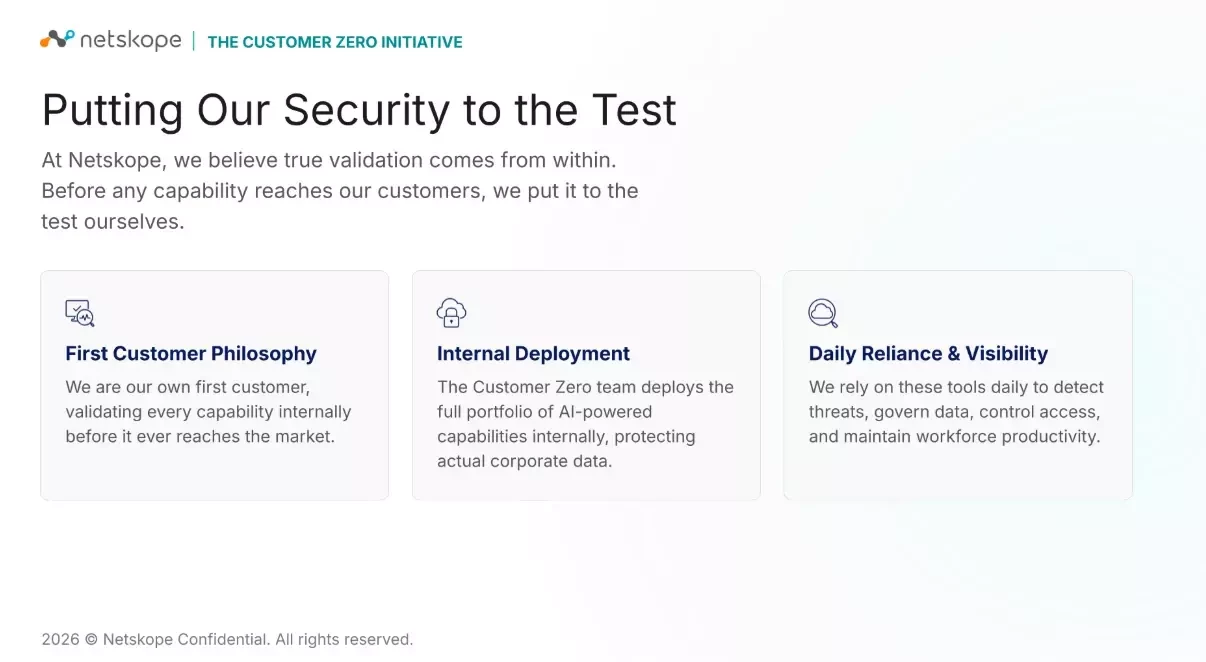
This isn't a case study from a customer. It's what we do every day. And the products we've deployed across our own environment paint a clear picture of where enterprise AI security is headed — and what it actually takes to get there.
Our internal security strategy is structured around four primary pillars, which collectively ensure that our AI-driven capabilities provide comprehensive protection across every layer of the organization.
| Capability | Problem Solved | Customer Zero Operational Result |
| Threat Detection | Static Rule Limitations | Improved Signal-to-Noise Ratio (Measured) |
| DCC/DSPM | Fragmented Data Views | 4x Tool Consolidation (Operational Efficiency) |
| AI Gateway/SPM | Unsanctioned AI/Shadow IT | Reduced Unsanctioned AI Surface |
| Browser/Agentic | Edge/Autonomous Risks | Validated "Zero-Theater" Control Policies |
Pillar 1: Proactive Threat Detection
AI-Powered Threat Detection That Learns Our Environment
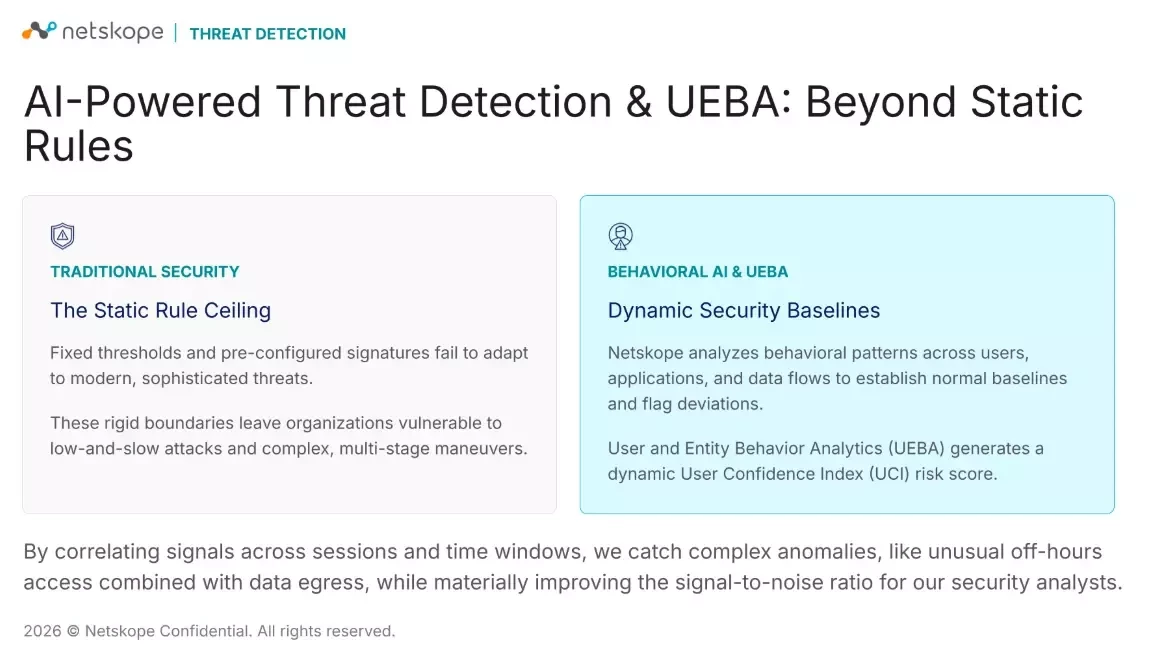
Traditional security tools are built around static rules. An IP reputation list, a known-bad URL, a signature that matches a threat catalogued six months ago. That approach has a ceiling — and adversaries figured out how to get above it years ago.
Netskope's AI-driven threat detection operates differently. By analyzing behavioral patterns across users, applications, and data flows in real time, the platform builds a baseline of what normal looks like for our environment — and flags deviations before they become incidents. For the Customer Zero team, this meant we started catching anomalies that rule-based policies would have missed entirely: unusual access patterns to sensitive repositories during off-hours, applications exhibiting unexpected data egress behavior, and credential use that didn't match a user's established profile.
The platform's machine learning models don't just score events in isolation. They correlate signals across sessions, users, and time windows to surface patterns that only become visible at scale. A single anomalous login might be noise. That same login combined with an unusual file access pattern three hours later combined with a data export attempt the following morning is a story — and Netskope's AI tells it before it ends badly.
What makes this operationally valuable isn't just the detection — it's the reduction in noise. Security teams drown in alerts. AI-correlated detections mean our analysts spend time on events that actually warrant investigation, not chasing false positives generated by tools that don't understand context. Since deploying AI-driven threat detection, the signal-to-noise ratio on our security queue has improved materially. That's not a marketing claim — it's something we measure.
Visibility is only useful if it’s actionable.
Pillar 2: Data Security Architecture
User and Entity Behavior Analytics: Risk Scores That Mean Something
Closely tied to threat detection is Netskope's UEBA capability — User and Entity Behavior Analytics. Where threat detection flags specific events, UEBA builds a longitudinal picture of risk across every user and device in the environment. The result is a User Confidence Index: a dynamic risk score that reflects not just what a user did in a single session, but their behavioral trajectory over time.
For the Customer Zero team, UEBA has been one of the most operationally impactful capabilities we've deployed. The risk scores inform how we triage incidents, how we tune our DLP policies, and how we think about access controls for high-risk populations. A user with an elevated UCI score doesn't automatically trigger a block — but they do trigger enhanced monitoring, additional friction on sensitive data transfers, and a faster escalation path if a correlated alert fires.
The real value of a behavioral risk score is that it travels with the user across every product in the platform. UCI data feeds into DCC, into our DLP policies, into our alert triage workflow. It's the connective tissue that makes Netskope's AI capabilities more than a collection of individual tools — it makes them a coherent security posture.
Data Security Command Center: Visibility We Couldn't Get Any Other Way
Data doesn't stay where you put it. That's the reality of a modern workforce using dozens of SaaS applications, collaborating across organizational boundaries, and increasingly relying on AI tools that ingest whatever they're given.
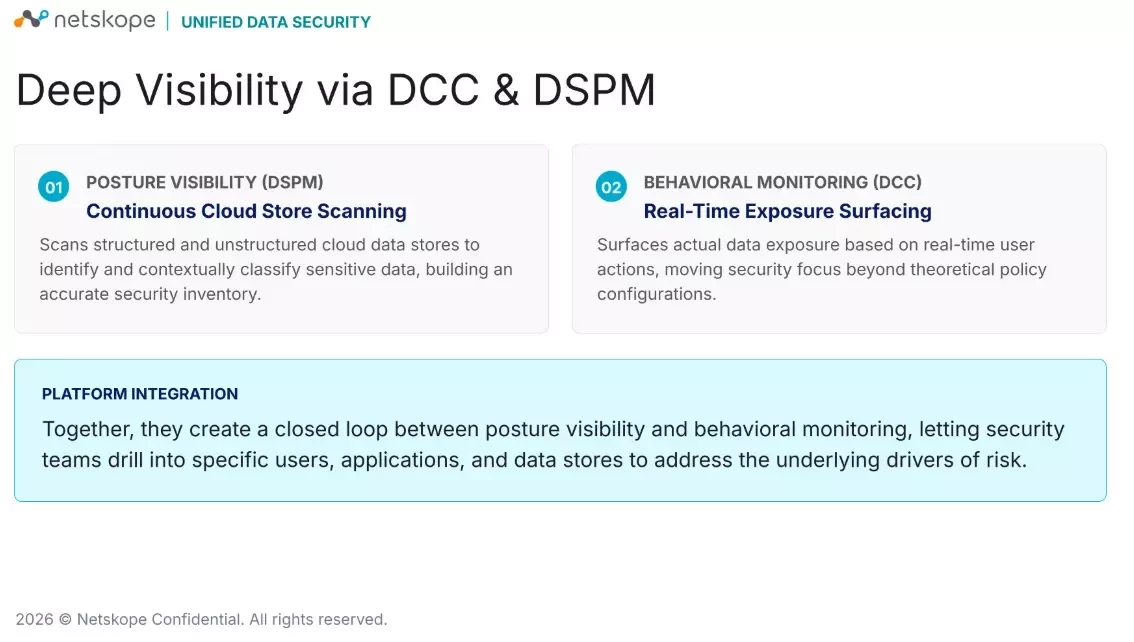
We deployed Netskope's Data Security Command Center (DCC) to get a clear picture of our data exposure. Not theoretical exposure based on policy configuration, but actual risk grounded in what our users are doing right now. DCC surfaces where sensitive data is moving, which users present elevated risk based on behavioral signals, and where our existing controls have gaps.
The overview dashboard gives us an immediate read on external user exposure, sensitive data access patterns, and risk concentration across the user population. The Risk Explorer lets us drill into specific users, data stores, and applications to understand the underlying drivers of our risk score. Together, they give the security team a unified picture of data risk that would previously have required stitching together outputs from four different tools.
One of the findings from our own deployment underscored why first-party validation matters: we identified that three UEBA-correlated risk policies were disabled in our environment with no visible explanation in the UI. Those policies which govern high-risk users sending data from high-risk apps, downloading sensitive data, and uploading to unsanctioned applications directly feed the behavioral risk scoring that makes DCC's threat detection credible. Finding that gap before a customer encountered it, and raising it with the product team, is exactly what Customer Zero is built to do. That catch came from actually using the product, not reading the documentation.
Securing the new enterprise attack surface.
Pillar 3: The AI & App Perimeter
Data Security Posture Management: Knowing What You Have Before You Can Protect It
You can't protect data you don't know about. That's the foundational problem DSPM solves — and it's a problem that gets harder as organizations expand their cloud footprint.
Netskope's DSPM capability scans structured and unstructured data stores across cloud environments — AWS S3, Azure Blob, Snowflake, Box, and others — to identify where sensitive data lives, how it's classified, and whether it's exposed in ways that violate policy or regulatory requirements. The AI-driven classification engine doesn't rely on simple pattern matching. It understands context, distinguishing between a Social Security number in a production database and the same format in a test dataset, and applying appropriate risk weighting to each.
For the Customer Zero team, DSPM deployment has been one of our more involved tracks. We've connected multiple cloud data stores to the platform and are actively building out classification policies that reflect Netskope's actual data taxonomy — not a generic template. The findings have been useful: data stores we thought were clean have turned out to contain residual sensitive content from historical migrations, and classification results have informed policy updates that were long overdue.
DSPM also feeds directly into DCC. The data store inventory, classification results, and exposure findings become inputs to the overall data risk picture — creating a closed loop between posture visibility and real-time behavioral monitoring. That integration is where DSPM moves from a compliance tool to a security control.
AI Gateway: Governing How the Business Uses AI
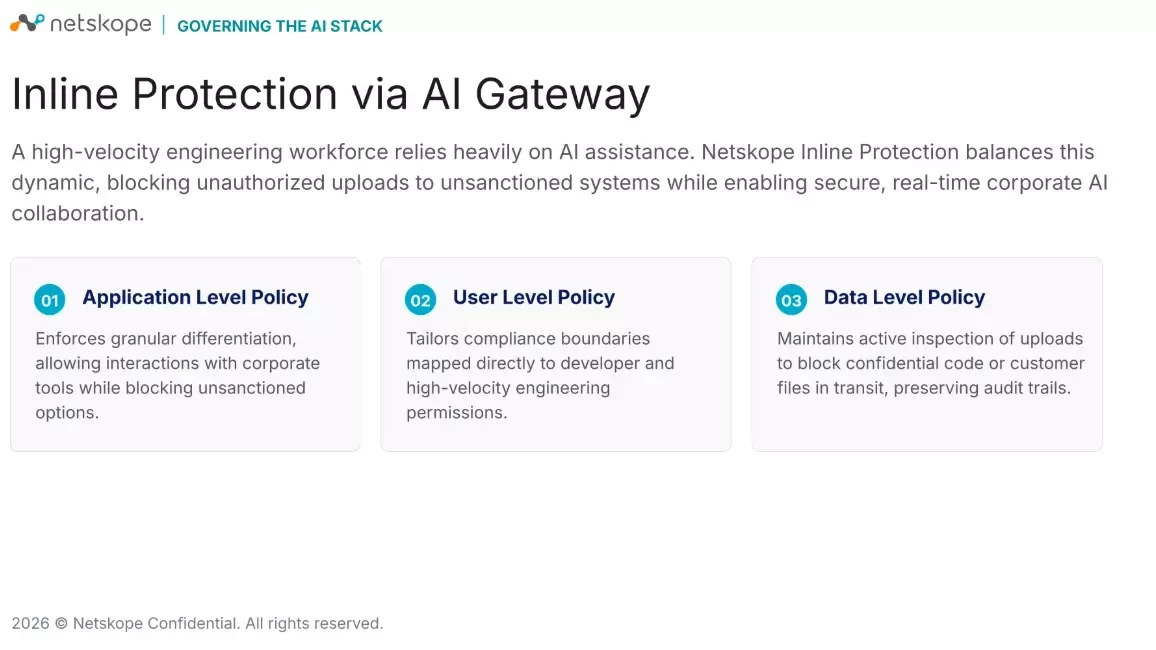
The fastest-growing attack surface in any enterprise today isn't a misconfigured server or an unpatched endpoint. It's the AI tools your workforce is already using. Employees are pasting sensitive data into large language models, using unsanctioned AI applications for work tasks, and interacting with AI agents that have unclear data retention and sharing practices.
Netskope's AI Gateway gives us visibility and control over exactly that layer. We inspect traffic to AI applications in real time, enforce data classification policies that prevent sensitive content from leaving the organization through AI prompts, and maintain an audit trail of AI usage across the business. For a security company that handles sensitive customer data and internal IP, this isn't optional; it's a core control.
The AI Gateway sits inline in our traffic flow and gives us granular control over which AI applications are sanctioned, which are tolerated with monitoring, and which are blocked outright. We can enforce policies at the application level, the user level, and the data level simultaneously by blocking an upload of a file classified as confidential to an unsanctioned AI tool while allowing the same user to interact freely with a sanctioned corporate AI assistant.
Deploying AI Gateway as Customer Zero also gave us firsthand experience with the configuration tradeoffs such as what policies are too aggressive for a technical workforce, where exception workflows are needed, and how to tune the product for a high-velocity engineering environment where developers are heavy AI users. That operational context feeds directly back into how the product team thinks about enterprise deployment for engineering-heavy organizations.
Securing the point of work and the future of execution.
Pillar 4: Modern Endpoints & Autonomy
AI Security Posture Management: Seeing the Risk in Your AI Stack
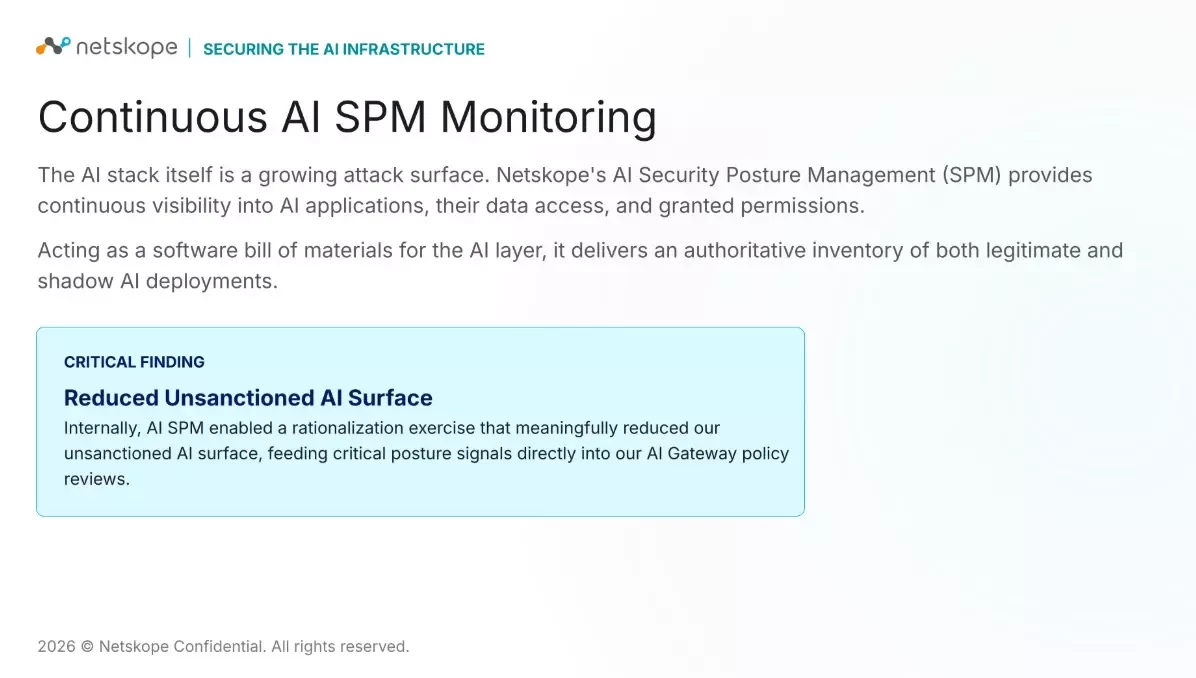
As AI applications proliferate across the enterprise, a new class of security problem has emerged: the AI stack itself becomes an attack surface. Models with excessive permissions, integrations that expose sensitive data to third-party AI services, and shadow AI deployments that bypass corporate governance — these are posture problems, not just behavioral ones.
Netskope's AI SPM capability gives us continuous visibility into the AI applications operating in our environment, the data they can access, and the permissions they've been granted. It's the security equivalent of a software bill of materials, but for your AI layer — a structured inventory of what's running, what it touches, and where the risk concentrates.
For the Customer Zero team, AI SPM has been an eye-opener. The number of AI integrations operating in our environment — many of them legitimate, some of them shadow deployments — was higher than anyone had formally tracked. AI SPM gave us an authoritative inventory for the first time, which became the foundation for a rationalization exercise that reduced our unsanctioned AI surface meaningfully. Applications that had been granted broad OAuth scopes to productivity tools were identified, evaluated, and either formally sanctioned or revoked.
The posture findings also inform our AI Gateway policy configuration. When AI SPM identifies a new application accessing sensitive data stores, that signal flows into our gateway policy review — ensuring that real-time traffic controls stay aligned with the actual AI application landscape.
Enterprise Browser: AI-Powered Controls at the Point of Work
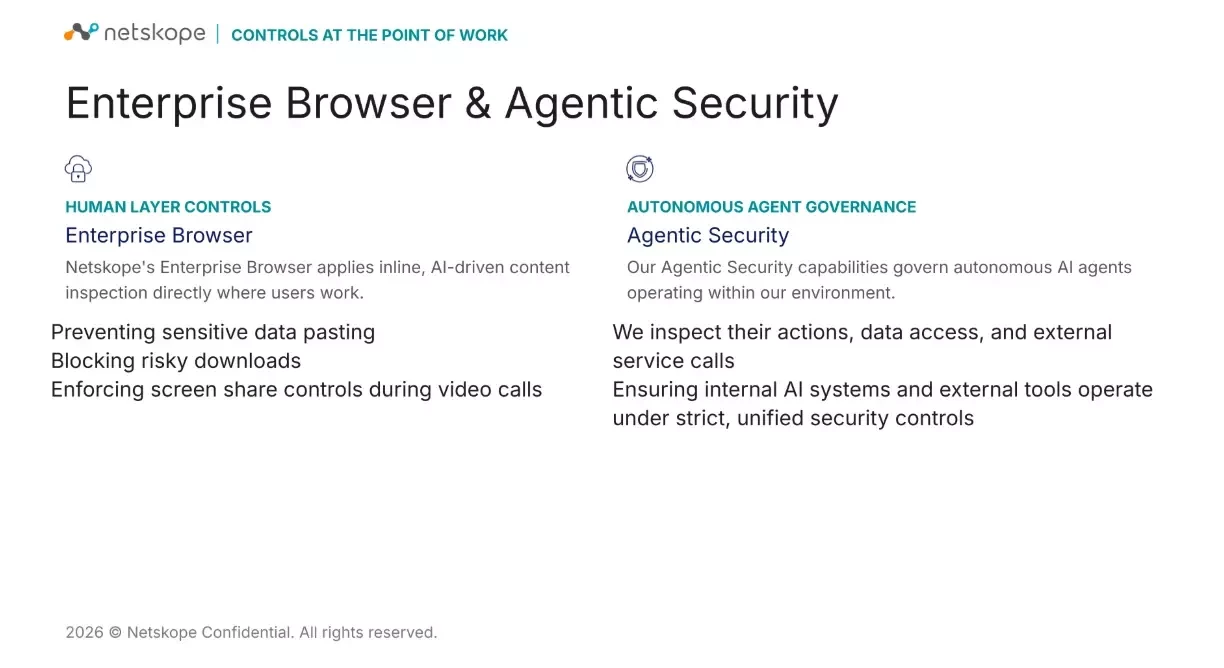
The browser is where work happens. It's also where data leaks, where credentials get stolen, and where users interact with AI tools that may or may not meet corporate security standards. Netskope's Enterprise Browser extends our security posture to the browser layer — and AI is central to how it does that.
The Enterprise Browser applies AI-driven content inspection inline, analyzing what users are doing in web applications in real time. It can detect when a user is about to paste sensitive content into a web form — including an AI chatbot — and apply the appropriate policy response before the data leaves the endpoint. It can enforce screen share controls that prevent sensitive data from being inadvertently exposed in video calls. It can block file downloads from risky applications and apply data classification to content as it moves through the browser.
For a workforce that lives in web applications and increasingly relies on browser-based AI tools, this layer of control is not redundant with what we do at the network level — it's complementary. Network-level inspection handles encrypted traffic and application-level data flows. Browser-level inspection handles the human layer: the copy-paste, the screenshot, the manual upload that bypasses every upstream control.
As Customer Zero, we've been running Enterprise Browser in our environment and generating feedback that's directly shaping product development. The configuration options, the user experience tradeoffs, and the false positive profiles all look different in a real production environment than they do in a lab — and that's exactly the kind of signal the product team needs before GA.
Agentic Security: Getting Ahead of the Next Frontier
AI agents are no longer a future problem. Autonomous agents that browse, execute code, send messages, and interact with external services on behalf of users are already operating in enterprise environments — often without formal security review or visibility into what they're doing.
Netskope's agentic security capabilities extend our platform's visibility to this new layer. We can inspect and govern the actions of AI agents operating in our environment — understanding what data they're accessing, what external services they're calling, and whether their behavior aligns with policy. For an organization that's actively experimenting with AI agents for productivity and operations, this is not a theoretical requirement. It's a live security problem we're managing today.
The Customer Zero team's AI initiatives — including the CoS AI system that coordinates much of our own operations — operate under the same security controls we apply to every other AI workload in our environment. Just as we inspect and block sensitive data egress via AI Gateway, our Agentic Security layer inspects the intent and execution of our internal CoS AI system. We apply the same principle of least privilege here as we do to human users, validating that the controls we ship for customers are robust enough for our own mission-critical automation. That's not a constraint; it's a design requirement. Security controls that only apply to external AI tools and not to internal ones aren't controls — they're theater.
Conclusion
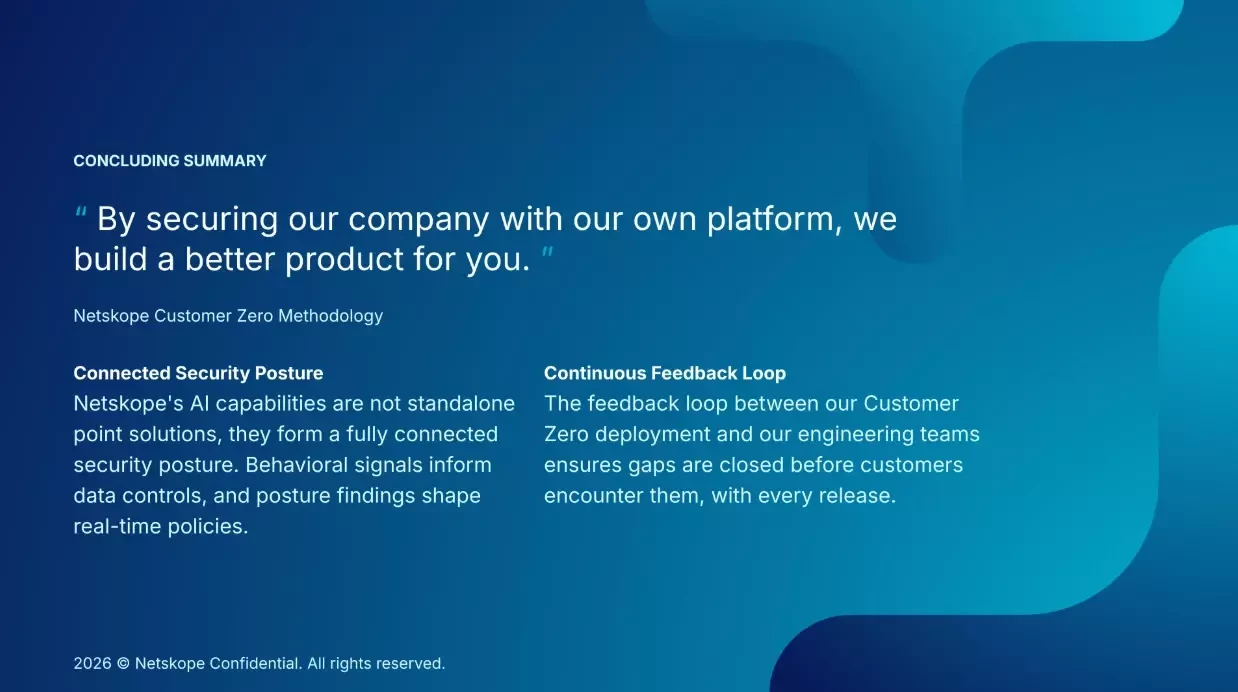
The phrase "eating your own dog food" has always been a little too humble for what Customer Zero actually does. We're not just testing products — we're operating them under real security requirements, with real data, for a company that is itself a security vendor with a reputation on the line.
Across threat detection, UEBA, DCC, DSPM, AI Gateway, AI SPM, Enterprise Browser, and agentic security, Netskope's AI capabilities don't operate as standalone point solutions. They form a connected security posture — where behavioral signals inform data controls, posture findings shape real-time policies, and every layer of the stack contributes to a coherent picture of risk.
Using these products to secure our own environment means we have zero tolerance for security theater. When a capability works, we know exactly why. When it has gaps, we find them first and close them before a customer ever encounters them. And the feedback loop between our deployment experience and the engineering and product teams is how Netskope's AI security capabilities get sharper with every release.
If you're evaluating AI-powered security tools, the best reference check isn't a customer slide or an analyst report. It's whether the vendor trusts their own product enough to run their entire business on it. We do — and we're better for it.